Gaming Laptop vs Gaming Desktop in India (2026)
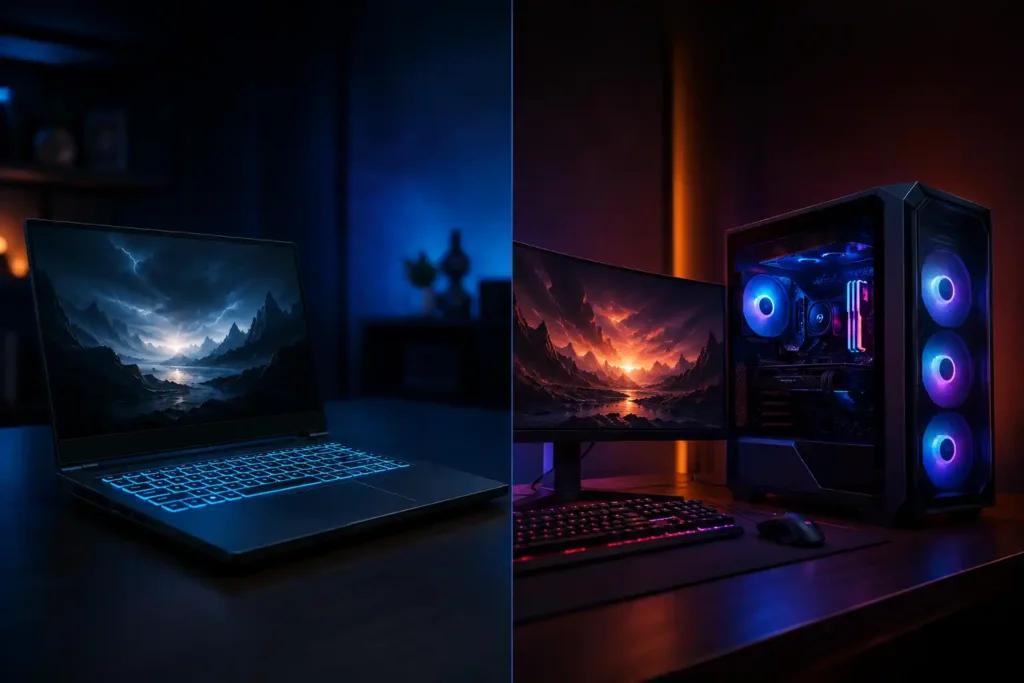
You’ve saved up somewhere between ₹60,000 and ₹90,000. The plan is clear — finally build or buy a proper gaming setup. But then comes the question that stalls everything:
Should I buy a gaming laptop or a gaming desktop?
This one question has probably cost you three weeks of YouTube rabbit holes, five Reddit arguments, and at least two confused DMs to people who barely know the difference themselves.
Here’s the thing — gaming laptop vs gaming desktop in India isn’t a question with a single right answer. Anyone giving you a one-liner without asking about your life situation is either guessing or trying to close a sale.
This post breaks it down honestly — performance, pricing in INR, real-world use cases, and who should actually be buying what in 2026. No fluff. Just the stuff that helps you spend your money right the first time.
First, Understand What You’re Actually Choosing Between
Before getting into specs and benchmarks, understand the fundamental difference in what these two things are.
A gaming laptop is a complete, sealed system. The display, keyboard, trackpad, speakers, battery — everything is integrated. You pay a convenience premium for all of that being in one portable package.
A gaming desktop is a performance platform. Whether you buy a prebuilt or build it yourself, almost every rupee goes directly into raw hardware. There’s no portability overhead, no battery, no compact cooling compromise — just components doing their jobs at full capacity.
The battle isn’t “which is more powerful.” The battle is: which gives you the right balance of performance, value, and practical fit for your actual life in India.
Let’s dig in.
Performance: Where the Real Gap Lives
CPU Performance
Modern gaming laptops pack genuinely capable processors in 2026. AMD Ryzen 7 8845HS and Intel Core Ultra 7 chips handle gaming, multitasking, and even light content creation without complaint.
But there’s a catch that the spec sheets don’t highlight — power limits.
A desktop Ryzen 7 7700X operates at a 105W TDP with room to boost further. The equivalent mobile chip in a laptop is capped at 45W–65W depending on the laptop’s thermal design. Under sustained workloads — long gaming sessions, simultaneous streaming, video rendering — that gap shows up clearly in real-world usage.
For most gamers playing titles like Valorant, GTA V, or even Elden Ring, this won’t break your experience. But if you’re streaming while gaming, running simulation-heavy titles, or doing video editing alongside — the desktop CPU’s breathing room becomes a meaningful advantage.
👉 Read Also
5 Best Processors to Buy in 2026: Ryzen vs Intel Core Ultra Compared
Read Full Details →GPU Performance: The Bigger Story
This is where Indian buyers need to pay close attention.
Take the RTX 4060 — arguably the most popular GPU in the ₹60K–₹90K budget segment.
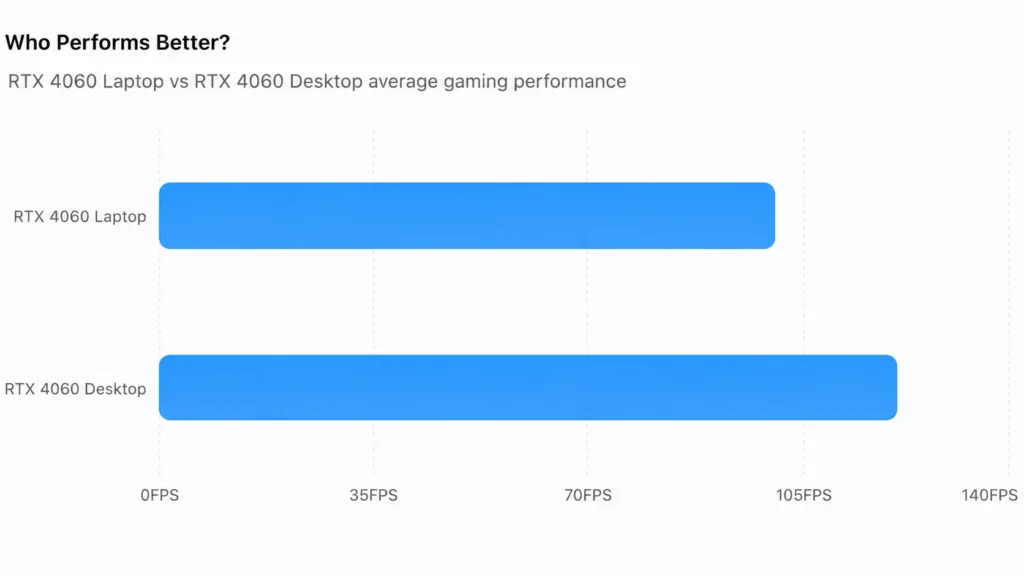
The desktop RTX 4060 runs at a full 115W TDP . The RTX 4060 Mobile inside a gaming laptop? It runs between 80W–115W depending entirely on what the laptop manufacturer decides to allocate.
Premium laptops from ASUS ROG or Lenovo Legion Pro give the mobile GPU near-full power. But most laptops in the ₹90,000–₹1,30,000 range quietly underclock the GPU to manage heat and battery life — and you end up with performance that’s closer to a desktop RTX 4050 than a 4060.
In real-world testing across titles like Cyberpunk 2077, The Last of Us Part I, and Call of Duty, a full-power desktop RTX 4060 consistently outperforms its mobile counterpart by 15–25% — on the same paper spec.
Thermal Throttling: A Major Challenge for Indian Gamers
This point doesn’t make it into enough comparison articles, so let’s say it clearly.
India is hot. Brutally hot for 4–6 months of the year.
A gaming laptop in a non-AC room during a Delhi or Nagpur summer will throttle. Thermal throttling is when the processor detects dangerous heat levels and deliberately reduces its own performance to avoid damage. You paid for RTX 4060 performance — you’re getting RTX 4050 performance — because your room is 34°C and the laptop’s slim cooling system physically cannot dissipate heat fast enough.
Desktops don’t have this problem. A mid-tower case with 2–3 case fans maintains component temperatures comfortably even in Indian summers, as long as the room has basic air circulation. A ceiling fan is usually enough.
If you’re in a non-AC room for more than 6 months a year, this single factor should heavily influence your decision.
Price vs Performance: The INR Reality Check
This is where most Indian buyers feel the pinch — and where honest advice matters most.
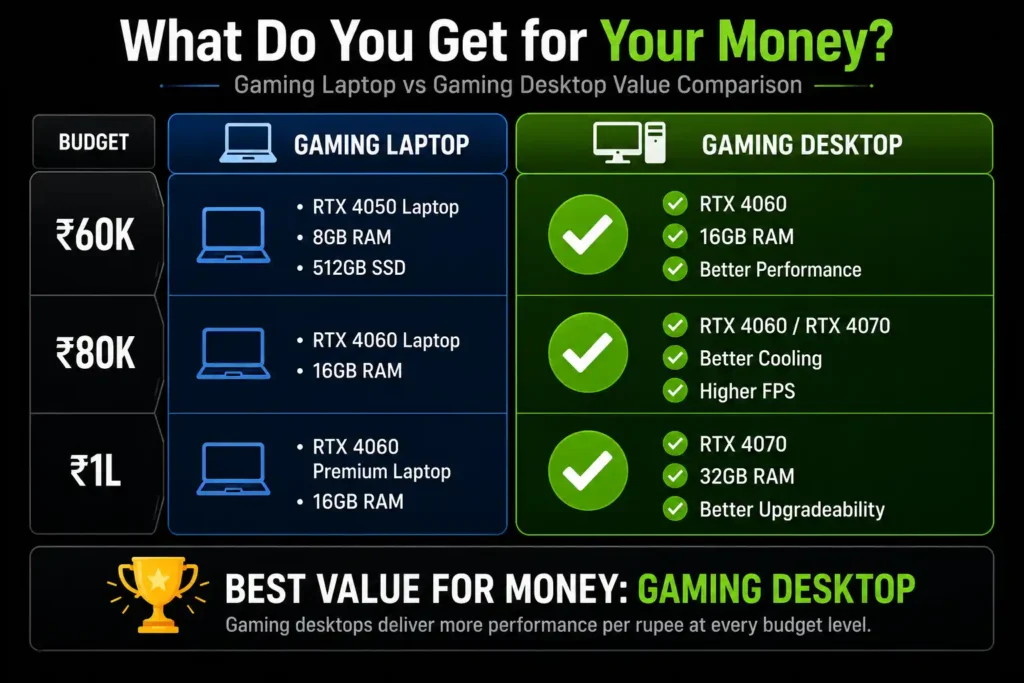
Budget: ₹55,000–₹70,000
At this range, a gaming laptop puts you in HP Victus 15 or Lenovo IdeaPad Gaming 3 territory. You’re getting an RTX 4050 Mobile, a 144Hz display, and often 8GB single-channel RAM — which itself is a performance bottleneck. These machines game, but they’re compromised.
A gaming desktop at the same budget puts you with an RTX 4060 + Ryzen 5 7600, 16GB dual-channel DDR5, a 512GB NVMe SSD , and a decent B650 motherboard. The performance gap is not marginal — it’s a full generation of GPU difference.
Budget: ₹75,000–₹1,00,000
This is where the laptop segment becomes genuinely interesting. ASUS TUF A15 /F17, Lenovo Legion 5, HP Omen 16 — these are solid machines with RTX 4060 Mobile, 165Hz+ displays, and proper cooling. Legitimate options if you need portability.
But at the same budget, a desktop gets you an RTX 4070 + Ryzen 7 7700, 32GB DDR5, 1TB NVMe — a setup that will handle everything comfortably for the next 4–5 years.
Budget: ₹1,20,000+
Now laptop territory gets serious. ASUS ROG Strix G16 , Lenovo Legion 5 Pro, MSI Raider — high-TGP GPUs, QHD displays, robust cooling. At this price, a gaming laptop is a genuinely strong choice.
The desktop at ₹1.2L+ enters RTX 4070 Ti / RX 7900 GRE territory with a 27″ QHD 165Hz monitor, mechanical keyboard, and money to spare.
The cold truth: At every price point, the desktop delivers more performance per rupee. The laptop is charging you a ₹15,000–₹25,000 portability tax depending on the segment. Whether that tax is worth paying depends entirely on your lifestyle — not on specs.
Portability: The Honest Version
“Portability” is the word gaming laptop marketing is built on. Let’s be real about what it means.
Most gaming laptops weigh between 2.2 kg and 2.8 kg. Add the power brick — another 600–900 grams. You’re carrying 3+ kg in your bag every day.
Most people who buy gaming laptops for the portability stop lugging them around within the first month.
- Hostel or PG students who travel home every 2–3 monthsStrong build quality.
- People who change rented accommodation frequently and can’t set up a permanent desk.
- Those who game at relatives’ places during vacations or festivals.
- Working professionals who occasionally need their setup during travel.
If any of these describe the next 2–3 years of your life — the portability argument is real, valid, and worth paying for. If not, you’re paying for portability you’ll never use.
Upgradeability: The Long Game
A gaming desktop is not just a purchase. It’s a platform investment.
Three years from now when your GPU starts struggling with newer titles — you remove it, sell it on OLX for ₹15,000–₹20,000, drop in a new GPU, and you’re back to current-gen performance. Your CPU, RAM, storage, cabinet, and PSU carry forward. You’re not starting from scratch.
A gaming laptop is different. When the GPU ages out, the entire laptop ages out. Most modern gaming laptops have soldered GPUs — there’s no upgrade path. You can add RAM and an SSD in most cases, but the core performance components are permanent.
The used PC parts market in India — OLX, Facebook Marketplace groups, local resellers — is surprisingly active and functional. Desktop components hold resale value and are easy to sell or swap. This compounds the desktop’s value advantage significantly over a 4–5 year ownership window.
Display and Gaming Experience
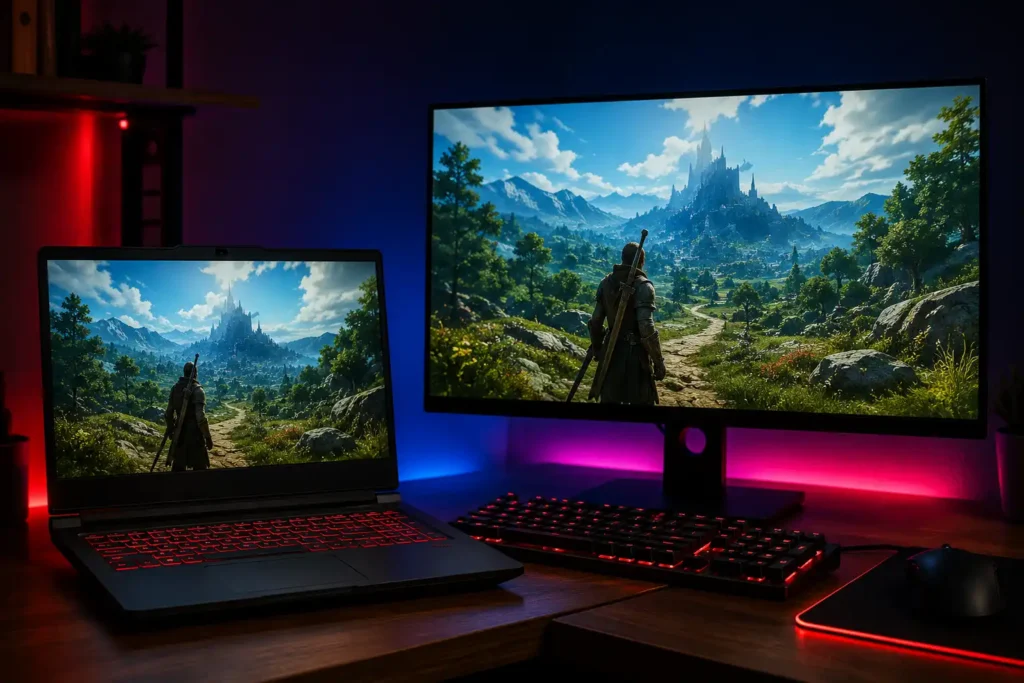
Premium gaming laptops in 2026 have excellent displays — 165Hz, 240Hz, QHD panels in upper-tier models. These aren’t the washed-out screens of five years ago.
But a desktop setup pairs with a dedicated monitor you choose yourself. A 27-inch 165Hz IPS monitor is available in India for ₹14,000–₹18,000. The visual real estate, adjustable height and angle, eye-level viewing, and sheer size make long gaming sessions noticeably more comfortable.
There’s also a practical health argument here: laptop gaming on a bed or couch for 3–4 hours is how you develop neck and back issues by your mid-twenties. A desktop with a proper monitor and chair setup keeps your posture correct and your sessions longer without discomfort.
If you do buy a gaming laptop, a ₹1,00,000 laptop stand and an external monitor at home transforms the experience completely.
Power Consumption: Understanding the Electricity Costs
This factor rarely comes up in comparisons, but it’s worth calculating in India.
A gaming desktop under full gaming load draws 350W–500W depending on the GPU class. At 4 hours of gaming per day, that’s roughly 50–60 units of electricity per month. At India’s residential tariff of ₹7–10 per unit, that’s ₹400–600 added to your monthly bill.
A gaming laptop on AC power draws 100W–180W under load — roughly ₹150–250 per month for similar usage.
The real-world monthly difference: around ₹250–350. Over 5 years that adds up to ₹15,000–₹21,000 in electricity costs — a genuine number.
Two additional India-specific points worth noting:
Power cuts: Laptops handle power cuts gracefully via their own battery. A desktop needs a UPS for protection — budget ₹3,000–₹5,000 extra if you’re in an area with frequent cuts.
AC dependency: A gaming laptop runs decently on an inverter setup. A high-end gaming desktop with RTX 4070 or above might exceed the capacity of a standard home inverter — worth checking before assuming seamless power backup.
Who Should Buy a Gaming Laptop in India?
- You’re a hostel or PG student who travels home regularly and genuinely games on the move.
- You change your living location every 1–2 years — rented PG, transfers, relocation for work.
- You need one machine for study + gaming + portability and simply can’t maintain two setups.
- You have a budget of ₹85,000 or above — below this, laptop thermal compromises significantly eat into the value.
- Your room genuinely doesn’t have space for a dedicated desktop corner.
- You’re okay with slightly lower performance in exchange for a complete all-in-one experience.
Who Should Buy a Gaming Desktop in India?
- You have a fixed, dedicated gaming spot — a table, a room, a permanent setup.
- You’re working with a budget under ₹85,000 and want maximum gaming performance.
- You play competitive titles — Valorant, CS2, BGMI PC — where high FPS on a proper monitor with a mechanical keyboard gives you a real gameplay edge.
- You want to upgrade in stages — GPU now, more RAM next year, better storage later.
- You’re a family PC buyer — the machine doubles for siblings’ schoolwork and parents’ browsing
- You’re into or planning to get into content creation — streaming, video editing, 3D work
Quick Budget Summary
| Budget (INR) | Best Laptop Option | Best Desktop Build | Verdict |
| ₹50,000–₹65,000 | HP Victus / Lenovo IdeaPad Gaming | RTX 4060 + R5 7600 build | Desktop wins clearly |
| ₹70,000–₹85,000 | ASUS TUF A15 / Lenovo Legion 5 | RTX 4060/4070 + R7 build | Desktop on performance; laptop if portability is real need |
| ₹90,000–₹1,20,000 | Lenovo Legion 5 Pro / HP Omen 16 | RTX 4070 build + QHD monitor | Depends on lifestyle |
| ₹1,20,000+ | ASUS ROG Strix / MSI Raider | RTX 4070 Ti / RX 7900 GRE build | Toss-up based purely on needs |
The Bottom Line
Here it is, said plainly and without hedging:
If you have a fixed place to sit and game — buy a desktop. The performance per rupee advantage in India’s market is too large to ignore. A desktop at ₹70,000 genuinely, measurably outperforms a laptop at ₹90,000. That ₹20,000 difference is a solid gaming monitor, right there. Decided to go with a desktop? Check out our complete Best Gaming PC Build Under ₹1 Lakh in India (2026) , featuring the exact parts list, latest prices, and expected gaming performance.
If you’re a student or frequent mover who genuinely needs portability — buy a laptop at ₹85,000 or above. Don’t compromise on budget in the laptop segment. The sub-₹70,000 gaming laptop market in India has too many thermal and performance trade-offs baked in. Spend enough to get high-TGP GPU allocation, proper cooling, and 16GB dual-channel RAM as a minimum.
And if someone tells you there’s a universal answer without asking about your life — they’re not actually helping you.
Frequently Asked Questions
Is a gaming laptop worth buying in India in 2026?
Yes — if portability is a genuine part of your life. For a fixed home or room setup, a gaming desktop gives significantly better value per rupee at every price point under ₹1,20,000.
Which is better for students — gaming laptop or desktop in India?
For hostel or PG students who move regularly, a gaming laptop makes the most practical sense. For students with a fixed room at home, a desktop delivers better performance for the same budget.
Can a gaming laptop fully replace a gaming desktop?
For casual to mid-level gaming, it can. For competitive gaming, content creation, or consistent maximum FPS — no. The desktop still wins on performance ceiling, thermal headroom, and long-term value.
Does a gaming laptop work properly in India without AC?
It works, but performance will drop due to thermal throttling in hot months. Premium machines from ASUS ROG and Lenovo Legion Pro manage this better than budget models. Budget gaming laptops in non-AC rooms in Indian summers will throttle noticeably.
What is the minimum budget for a good gaming laptop in India in 2026?
₹75,000–₹85,000 is the realistic minimum for a gaming laptop that won’t significantly compromise on thermal performance or GPU wattage. Below that, a desktop will serve you better.
Is building a gaming PC cheaper than buying a gaming laptop in India?
Yes. A custom-built gaming PC at ₹60,000–₹70,000 will outperform a gaming laptop at ₹80,000–₹90,000 in raw gaming performance, and offers better long-term upgradeability.
Which gaming laptop brands have good service centers in India?
ASUS, Lenovo, HP, and MSI all have reasonably distributed service networks across major Indian cities. Alienware’s service infrastructure in India is more limited and worth researching before purchasing.
